
Taekwondo Sparring Gear: The Full Kit List
Every piece your child needs for sparring, how to size it, how to put it on and how to keep it clean — explained by our Founder and Principal.
Ask Us About Sparring Gear
Every piece your child needs for sparring, how to size it, how to put it on and how to keep it clean — explained by our Founder and Principal.
Ask Us About Sparring Gear
Sparring is where taekwondo stops being something your child practises and starts being something they do. It is also the point at which a parent is suddenly handed a list of equipment and expected to know what a hogu is.
Or read the full kit list below.
Sparring gear is the set of padded protectors worn for kyorugi (겨루기), the Korean word for sparring. It covers the head, torso, forearms, shins, hands, feet, groin and teeth, and it exists for one reason: taekwondo scores points with kicks to the body and head, so the areas that get struck are the areas that get padded.
That is also why a taekwondo kit looks bulkier than the kit for arts your child’s friends might do. In judo there is nothing to pad because there is nothing being struck. In karate, contact is often pulled. In taekwondo the kick lands, and the protector is what makes that safe.
None of this applies on day one. A beginner spends months on stances, belt-level technique and pad work before sparring with a partner, and your first uniform is free when you enrol. Gear comes later, and we will tell you when.
A complete World Taekwondo (WT) sparring kit has nine pieces. Your child will not need all nine at once — competition-only items are marked.
The large chest guard, and the piece everyone pictures. It is worn over the dobok and covers the ribs and torso. In competition it is reversible — red on one side, blue on the other — so the two competitors can be told apart.
A padded open-face helmet covering the crown, temples and the back of the head. Head kicks score highest in taekwondo, so this is not optional once sparring begins. Some versions add a clear face shield.
A mouth guard is the piece of kit that prevents the most expensive injury. Boil-and-bite types mould to your child’s teeth at home in a few minutes, and a dentist can make a custom-fitted one that grips better and lasts longer. Replace it when it stops gripping, or after a growth spurt.
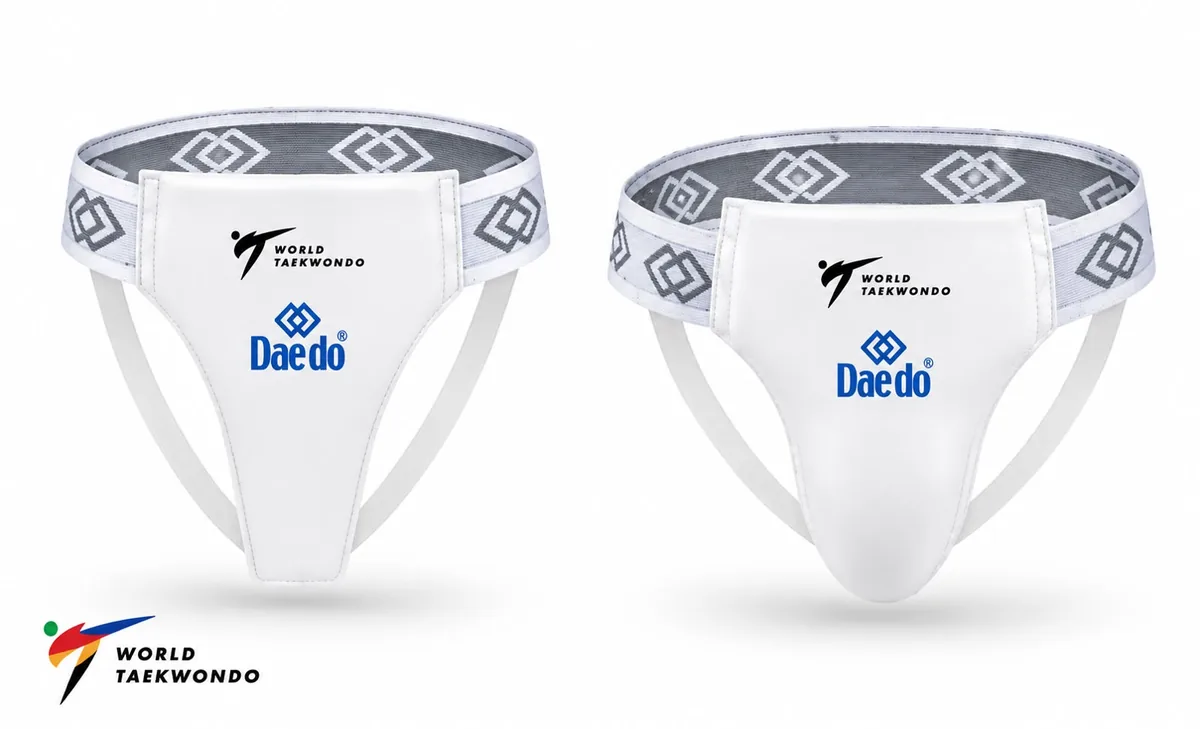
Worn under the dobok trousers, for boys and girls alike — the designs differ. Required for sparring without exception.
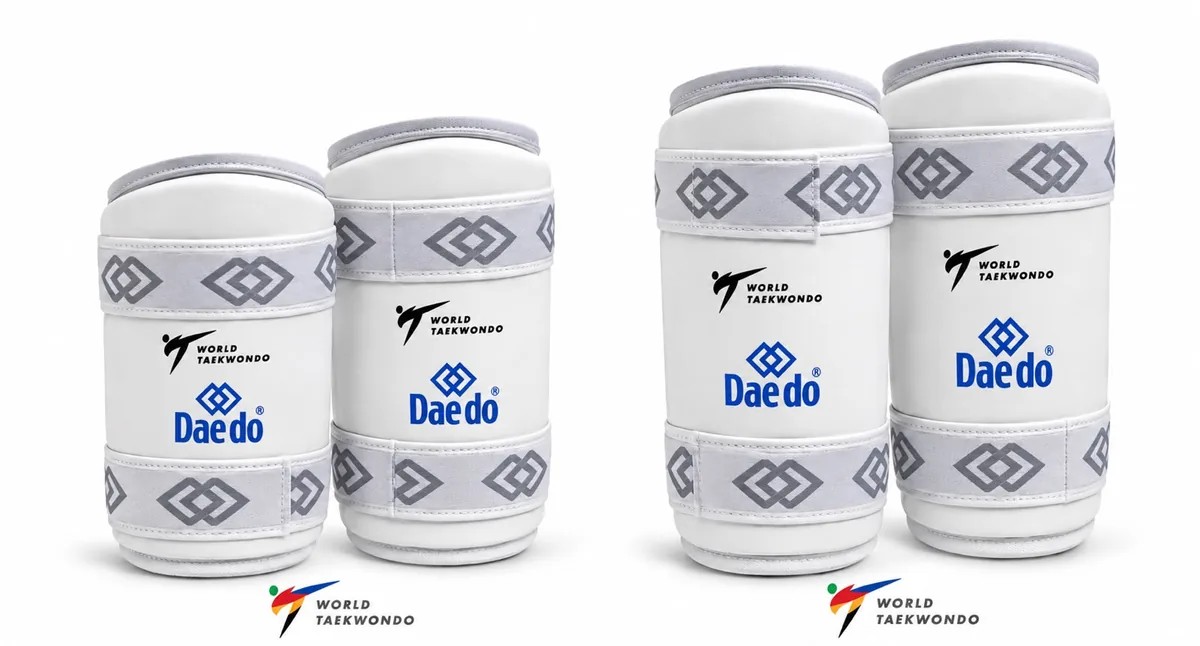
Padded sleeves protecting the forearms, which take the impact every time your child blocks a kick. They slide on before the dobok jacket.
Worn under the trousers and often moulded together with an instep pad. Taekwondo is a kicking art, so shin-to-shin contact is routine rather than accidental.
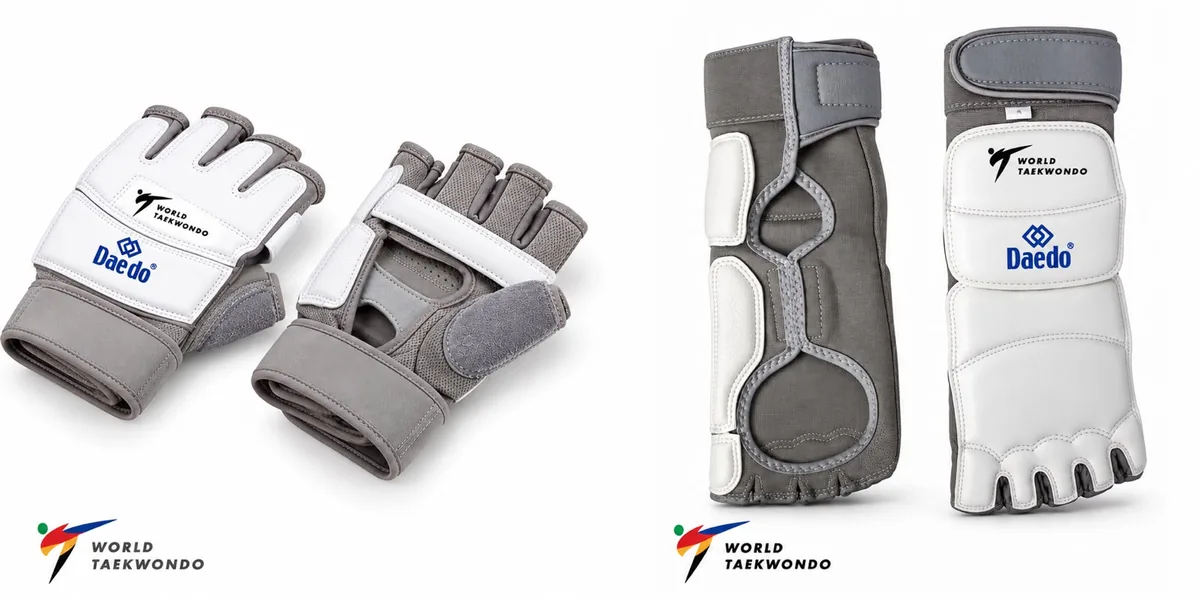
Light padded gloves that leave the fingers free. Punches to the body are legal in taekwondo sparring even though kicks score more, so the hands are padded too.
Padded covers for the instep and ankle, worn over bare feet. They protect the foot that is doing the kicking as much as the opponent being kicked, which is why they are standard rather than optional.
Electronic foot protectors that register a scoring kick against the opponent’s sensor-equipped hogu. These are only needed for electronically scored competition, not for class, and the system in use varies by tournament.
Taekwondo is governed internationally by World Taekwondo, which sets the equipment standards that competition gear is certified against. For class, certified gear is not required — correctly fitted gear is.
Sizing runs by height and weight, not by age or clothing size. Two ten-year-olds can need different sizes of everything, which is why we fit gear in person rather than letting parents guess from a chart.
It should cover the ribs without riding up into the armpits or hanging below the hips. Too large and it rotates when your child turns; too small and it leaves the lower ribs exposed.
Snug enough that a brisk head shake does not move it, loose enough not to press on the temples. If it slips over the eyes mid-round it has become a hazard rather than a protection.
Shin and forearm guards should stay put without being strapped tight enough to restrict circulation. Hand protectors should allow your child to close a fist completely.
On sizing up for a growing child: one size up is sensible. Two is not. Oversized gear shifts on impact, which is precisely when it needs to be where it was put. This is the same principle as sizing a dobok, but the consequences of getting it wrong are larger.
Not sure what size your child needs?
Book a FittingThe order matters, because several pieces go under the dobok and cannot be added once it is on. Teach your child this sequence once and they will manage it themselves from then on.
Sparring gear is foam and vinyl, not fabric. It does not go in the washing machine, and the reason parents eventually ask about cleaning is always the same — by then the smell has reached the car.
When to replace a piece: when foam has compressed and no longer springs back, when vinyl has split, or when straps no longer hold tension. Gear that has stopped holding its shape has stopped protecting, however new it looks.
Below are our current prices. All figures are in Singapore dollars (SGD) and cover gear we supply and fit in person.
| Item | Price |
|---|---|
| Trunk protector (hogu) | SGD 125.00 |
| Head gear with face shield | SGD 125.00 |
| Arm guard | SGD 50.00 |
| Shin guard | SGD 50.00 |
| Foot protector | SGD 50.00 |
| Hand gloves | SGD 50.00 |
| Groin guard | SGD 50.00 |
| Full set — all seven pieces | SGD 500.00 |
Pieces can be bought individually, so you are never obliged to take the full set at once. Most families build the kit up as their child needs it rather than buying everything on the same day.
Prices are current as of Nov 01, 2026 and may change.
We supply sparring gear directly, and we fit it in person. That is the part that matters. Sizing charts cannot tell you whether a hogu rides up when a particular child turns to kick, and a protector that fits badly is a protector that is not doing its job.
Speak to your instructor and we will:
If you would rather buy elsewhere, that is entirely fine — bring it to class and we will check the fit before your child uses it. What we would ask you to avoid is ordering a full kit online, unseen, based on your child’s age. Age is not a sizing unit, and an ill-fitting kit usually has to be bought twice.
Ready to get your child fitted?
Enquire About GearThe two main taekwondo styles spar under different rules, so they pad differently. We follow the World Taekwondo (WT) style, the Olympic one.
| Feature | World Taekwondo (WT) | ITF |
|---|---|---|
| Trunk protector | Yes — the hogu is central to scoring | Not typically worn |
| Head protector | Padded open-face helmet | Padded helmet |
| Hands and feet | Light gloves and foot protectors | Fuller padded mitts and boots |
| Contact level | Full contact to the body and head | Controlled contact |
| Electronic scoring | Used at competition level | Not used |
If you are working from a gear list, check which style it is written for before buying. ITF mitts and boots will not serve your child in a WT class.
A full World Taekwondo kit is a trunk protector (hogu), head protector, mouthguard, groin guard, forearm guards, shin guards, foot protectors and hand protectors. Sensing socks are needed only for electronically scored competition. You do not need any of it to start training.
Yes. Sparring gear is required for sparring — it is a safety rule, not a preference, and there are no exceptions. It is not needed for your free trial class or for early training, which focuses on technique and belt-level skills. Your instructor will tell you when your child is approaching the point of needing it.
No. Beginners spend months learning stances, kicks and forms, and practising on pads, before they spar with a partner. Nothing beyond a dobok is needed to begin, and your first dobok is free when you enrol.
The hogu is the padded trunk protector worn over the dobok, covering the ribs and torso. It is the piece most people picture when they think of taekwondo sparring. In competition it is reversible, red on one side and blue on the other, so the two competitors can be told apart.
Sizing goes by height and weight rather than age or clothing size. The hogu should cover the ribs without riding into the armpits, and the head protector should not move when the head is shaken. One size up is reasonable for a growing child; two is not, because oversized gear shifts on impact. We fit gear in person for exactly this reason.
Groin guard and shin guards first, under the trousers. Forearm guards before the jacket. Then the dobok and belt, the hogu strapped over the top, hand protectors, mouthguard, and the head protector last. Have your child jump on the spot — if anything shifts, re-strap it.
Air it after every session rather than leaving it sealed in a bag. Wipe the hogu, head protector and guards with a damp cloth and mild detergent. Hand-wash hand protectors in cool water. Rinse the mouthguard in cool water only. Dry everything in the shade — never in direct sun or a dryer, which makes foam brittle and splits vinyl.
Sparring is contact, and contact carries risk. That risk is managed by correctly fitted protective gear, by matching children sensibly, by supervision, and by not sparring until a student has the control to do it safely. Gear that fits badly removes much of that protection, which is why we fit it ourselves rather than leave it to a size chart.
A full set from us is SGD 500. Individually: trunk protector (hogu) SGD 125, head gear with face shield SGD 125, and SGD 50 each for the arm guard, shin guard, foot protector, hand gloves and groin guard. All prices are in Singapore dollars. A mouthguard is not included — see the full price list.
No. Pieces can be bought individually, and most families build the kit up as their child needs it rather than buying everything on the same day. Your instructor will tell you what is needed next.
We supply it directly and fit it in person — speak to your instructor. If you prefer to buy elsewhere, bring it to class and we will check the fit before your child uses it. We would discourage ordering a full kit online based on age alone, as it usually has to be bought twice.
When the foam has compressed and no longer springs back, when vinyl has split, or when straps no longer hold tension. Gear that has lost its shape has lost its protection, however new it looks. A mouthguard should be replaced when it stops gripping or after a growth spurt.
Whether your child is in kids taekwondo classes or training towards competition, we will tell you when gear is needed and fit every piece in person. If you are not training with us yet, start with a free trial — no gear and no uniform required.
Still not finding it? Ask us directly — we usually reply within the hour.